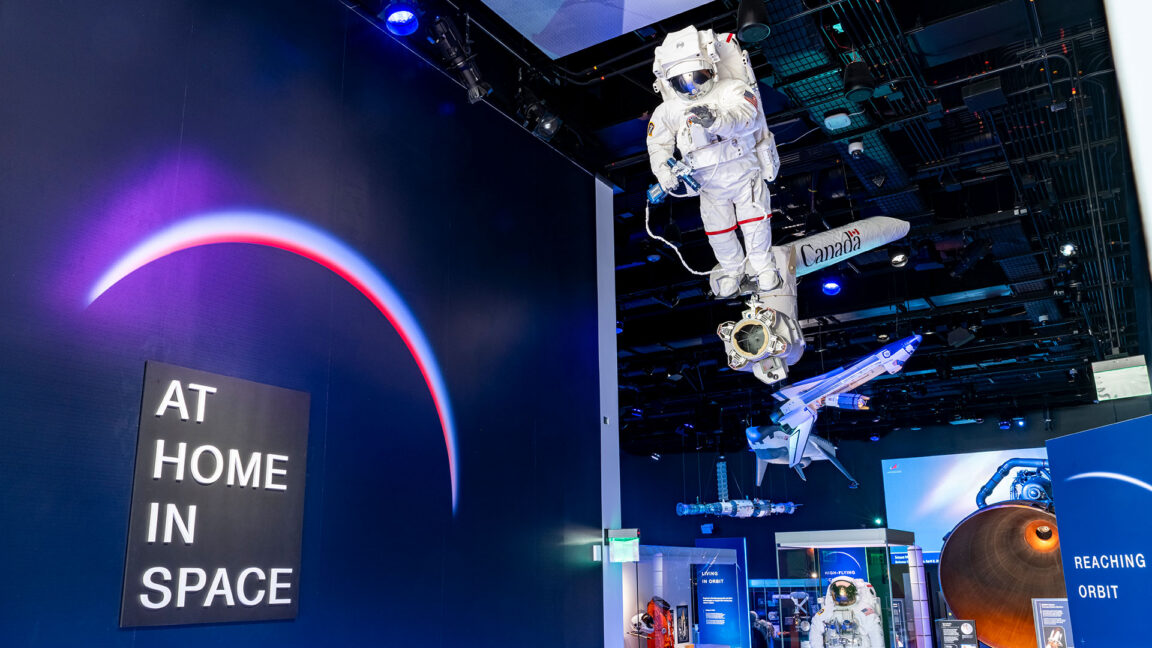
The Smithsonian's National Air and Space Museum in Washington, DC reopened fully on October 30 after seven years of renovation costing nearly $1 billion. The completion came with the opening of "At Home in Space," a gallery focused on long-duration spaceflight and humanity's capacity to live in orbit.
The gallery showcases artifacts including a space shuttle main engine, Robonaut 1A, and an extravehicular mobility unit (EMU) spacesuit that curator Jennifer Levasseur described as "the first and potentially only public display of a fully flown set of EMU equipment in the world." The suit, originally designed for the space shuttle program and still used on the International Space Station, lacks only a functioning portable life support system.
The gallery also displays in-flight suits worn by Guion Bluford, the first African American astronaut to fly the space shuttle, and Sally Ride, the first US woman to fly it. Both wore casual shirt-sleeve outfits for their missions.
"At Home in Space" includes recovered debris from the Challenger and Columbia shuttle disasters, making it only the second public display of fallen orbiter material after a 2015 Kennedy Space Center exhibit. The artifacts include an elevon hinge from Challenger, a wiring panel from Challenger's payload bay, a reinforced carbon-carbon panel from Columbia's starboard wing, and a compact disc on loan from astronaut David Brown's family.
Visitors can walk through a full-size mock-up of the International Space Station's Destiny module, the US national laboratory. The module features interactive elements and equipment used in space, including microgravity-engineered coffee cups, a flown miniPCR biotech toolkit, a MinION portable DNA sequencer, and the first 3D printer used in space, built by Made In Space (now part of Redwire) and NASA in 2014.
The gallery includes scent displays allowing visitors to smell space and the ISS, and concludes with space reserved for the Artemis I capsule, which flew to the Moon without crew in 2022. A Lockheed Martin scale model of the Orion spacecraft currently holds the place until NASA delivers the real capsule later this year.
The full museum renovation included refacing exterior cladding and replacing mechanical systems. The first phase reopened in 2022 with eight galleries and the Northrop Grumman Planetarium. The second phase opened in 2025, followed by five additional galleries on July 1. "Modern Military Aviation" opens November 11. Admission remains free, though timed-entry passes are required.