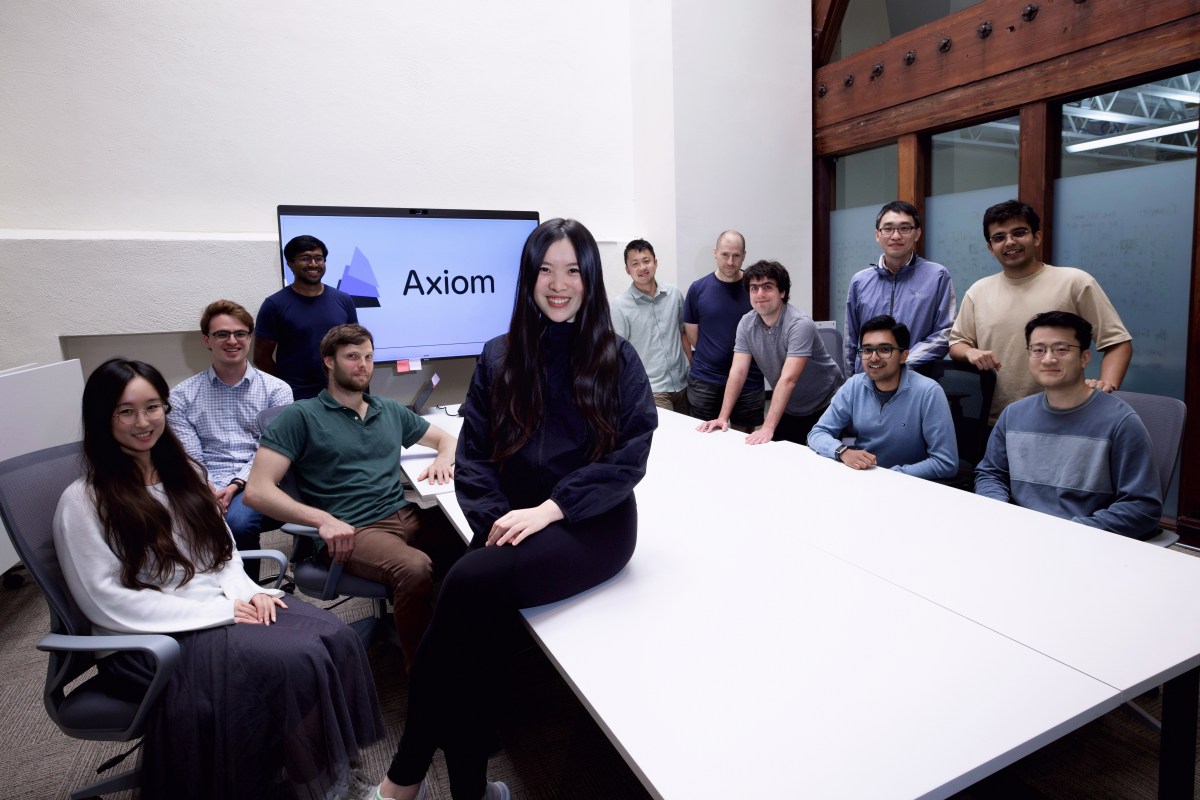
The $1.6 billion startup Axiom Math just accomplished something that should make every company betting on AI agents sit up and pay attention. On Wednesday, the company announced it had formally verified the Stacks Project, translating roughly 7,654 pages into about 16 million lines of computer-checked code in the programming language Lean. This isn't just a technical flex—it's a blueprint for how AI infrastructure needs to be built if we want it to do anything meaningful beyond generating plausible-sounding nonsense.
The stakes here are genuinely high. Last month, OpenAI released 719 manuscripts claiming solutions to some of mathematics' hardest problems, but even the computer checks meant to confirm those results can slip. That's the AI slop problem in a nutshell: without verified foundations, we're just stacking hallucinations on top of each other. Axiom's approach—using formal verification to ensure the logical soundness of mathematical proofs—mirrors how engineers check chip designs and how researchers in France caught bugs in software calculating family benefits. The difference is scale and interconnectedness. The Stacks Project's 16 million lines of Lean code had to preserve every single connection between theorems and definitions, a delicate web that Axiom CEO Carina Hong worried might break.
What's instructive is how Axiom's 25-year-old founder, who dropped out of Stanford's math PhD program in March 2025 and raised a $200 million Series A led by Menlo Ventures that same month, approached the problem. Rather than imposing rigid top-down control, the company's AI agents worked in parallel, finding tasks for themselves. The team trained its own models specifically for mathematics—something Hong said most other verification startups haven't done—letting agents develop what she calls a sense of taste for good work over time. This fills what Ashvin Swaminathan calls 'this huge black hole' in formalized mathematics: algebraic geometry, where researchers previously had little verified material to build upon.
The real argument here isn't just about mathematics. It's about what happens when AI agents start writing software at scale. As Hong told TechCrunch, bad engineering choices early on make it 'very hard for them to grow that boundary.' If AI agents are going to be trusted with consequential work, they need to build on verified foundations, not on the shifting sand of plausible-sounding approximations. Terence Tao, the UCLA mathematician and Fields Medal winner, put it simply: 'The more formalized proofs you have, the more formalized proofs you can make.'
Hong is so confident in this approach that she openly challenges all the coding companies to work on formalization at this scale. She's right to. The companies that recognize this—that AI's future depends on building on rock instead of quicksand—will be the ones that produce reliable systems. The rest will keep drowning in slop.