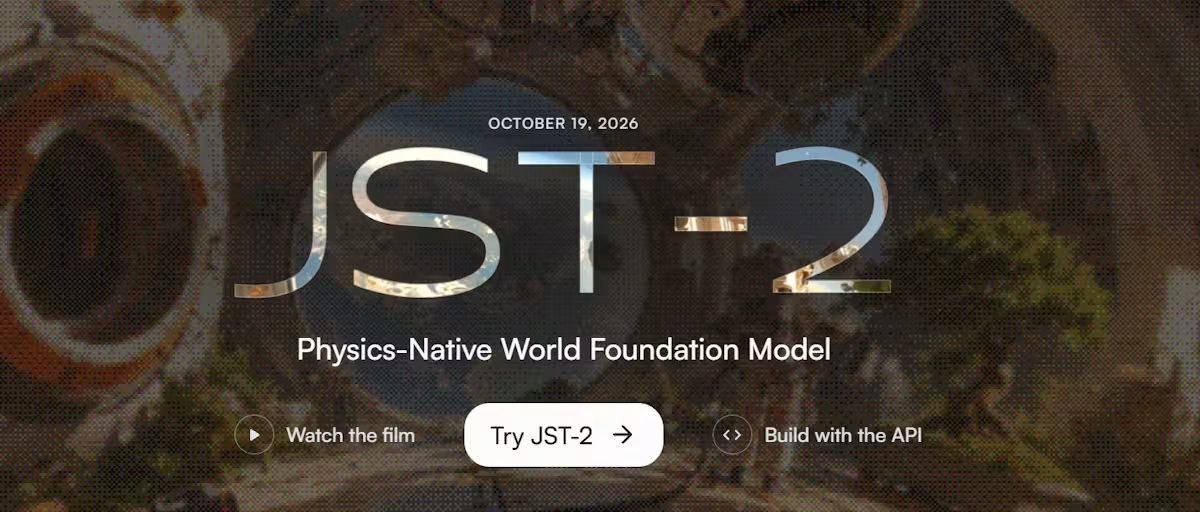
Viggle released JST-2, a physics-native foundation model that generates 3D scenes, characters, and full-body motion within a single shared 3D world.
The model addresses a workflow problem. Building 3D content currently requires separate tools and specialists for scenes, characters, rigging, and animation. Rigging and skinning alone can take hours and constrain how characters move afterward.
JST-2 combines all three tasks. Viggle's architecture represents the world as persistent 3D "atoms" with learned attributes and dynamics, encodes them as Physics-Native Tokens, and decodes them into images or 3D Gaussian splats. Characters come with motion built in, eliminating separate rigging or skinning steps. Scenes can be explored without rerunning the model.
A 3D scene generates in about one second, compared to 5 to 6 minutes for Marble, with inference costs below $0.01 per scene. In Viggle's blind human tests, JST-2 was preferred over Meshy 7.1 and Tripo H3.1 for characters, and over HY-Motion-1.0 and DeepMotion Animate 3D for motion.
The platform handles scene generation from prompts or images, expands worlds one view at a time up to 64 input views, and reconstructs real environments from sparse images for robot simulation. Characters generate full-body 3D forms from one image or text, including cropped or partly hidden images, with detailed faces and individual finger movement. Motion applies to JST-2 characters and works with standard 3D rigs.
Viggle offers PINOC, a free browser app with Scene mode and Agent mode, plus an API with MCP support for agents like Codex and Claude Code.