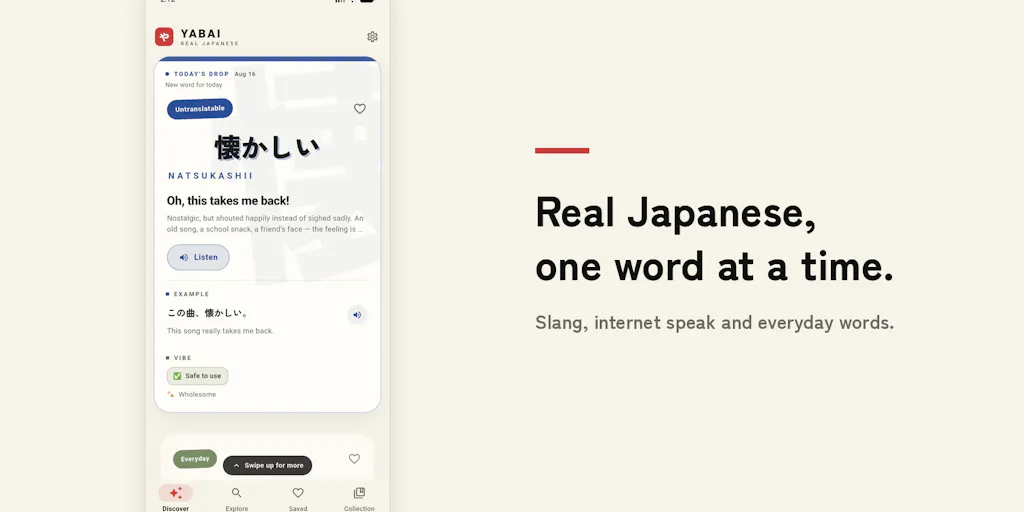
YABAI, a new language learning product, launches with a focused thesis: teach real Japanese slang one word at a time.
The product targets learners frustrated with traditional language apps that emphasize formal grammar and textbook vocabulary over colloquial speech. YABAI strips away unnecessary complexity. Each lesson isolates a single slang term, providing context, usage examples, and cultural nuance that explains when and how native speakers actually use the word.
The name itself reflects the product's mission. "Yabai" translates roughly to "risky" or "sketchy" in Japanese, but carries layers of meaning depending on context. Native speakers use it to describe everything from genuinely dangerous situations to impressively good moments. The wordplay signals YABAI's positioning: it's teaching the language native speakers actually speak, not the sanitized version found in textbooks.
The slang-first approach addresses a real gap in the language learning market. Duolingo, Rosetta Stone, and Babbel dominate consumer language education by serving broad audiences learning multiple languages. Those platforms optimize for retention and engagement metrics rather than authentic conversational fluency. Learners who complete courses often struggle in actual Japanese environments because they've mastered formal speech but lack the colloquial toolkit that makes conversation feel natural.
YABAI enters a niche market that includes specialized Japanese resources like Marugoto Online Courses and various Discord communities centered on Japanese culture. Unlike those options, YABAI appears designed as a standalone product with a clean interface and gamified progression. Product Hunt listing suggests mobile-first delivery, which aligns with how younger language learners consume content.
The timing favors niche language products. Interest in Japanese language and culture remains strong among Gen Z consumers. Anime, manga, and Japanese pop culture drive curiosity about authentic Japanese speech. Learners increasingly reject one-size-fits-all platforms in favor of specialized tools that serve specific learning styles or cultural interests. This mirrors broader consumer behavior where narrowly focused products outcompete generalist alternatives in engaged niches.
YABAI's distribution strategy hinges on Product Hunt launch and organic growth through Japanese learning communities. The product likely targets learners already intermediate in Japanese who can handle slang without foundational grammar support. This narrows total addressable market but increases retention potential. Early adopters will likely be self-directed learners on Reddit communities like r/LearnJapanese and fans of anime who want to understand untranslated dialogue.
Monetization remains unclear from available information, but subscription models dominate language learning. YABAI could charge monthly for expanded slang libraries, advanced lessons, or community features. Freemium approaches work well for language products. The core value proposition, however, needs validated demand. Early metrics will reveal whether learners prefer a dedicated slang app or integrate slang learning within broader platforms.
Success depends on execution depth. Teaching slang requires native insight into cultural context and usage frequency. Surface-level definitions fail. YABAI must demonstrate authentic understanding of when learners should deploy specific terms and how social hierarchies affect word choice in Japanese.
The product solves a specific problem for a specific audience. Whether that audience is large enough to sustain a standalone company remains the central question.