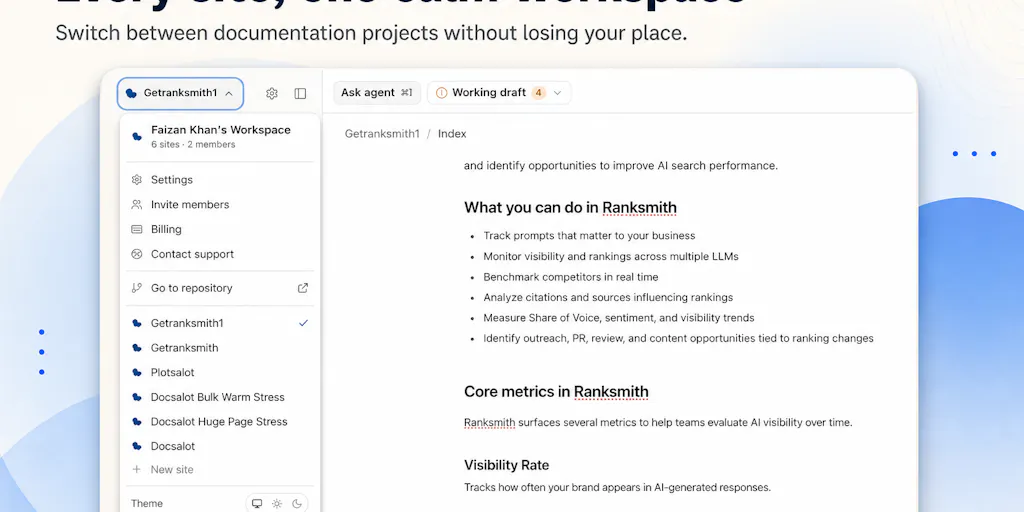
DocsAlot launches Visual Editor, a document creation tool that emphasizes human-driven design over artificial intelligence. The product positions itself against the growing wave of AI-powered writing assistants by letting users build polished documentation through straightforward typing and visual formatting controls.
The tool arrives at a moment when document creation faces fragmentation across multiple platforms. Teams juggle Google Docs for collaboration, Notion for knowledge management, Confluence for technical documentation, and specialized tools for design specs. DocsAlot targets this gap with a focused approach: deliver a visual editor that produces professional output without requiring users to adopt AI workflows or adopt complex markdown syntax.
The visual editor removes friction points that plague existing documentation tools. Users type naturally while the interface handles formatting, layout, and styling in real time. This approach mirrors how modern no-code platforms work, putting design control directly in the hands of creators rather than hiding it behind configuration panels or prompt engineering.
The "no AI required" positioning carries strategic weight. While generative AI has reshaped writing tools over the past eighteen months, not all teams want or need AI-assisted content. Some organizations face data privacy concerns with cloud-based AI services. Others distrust AI output quality for technical or regulated documentation. DocsAlot captures this segment by offering speed and beauty without algorithmic intermediation.
Product Hunt serves as the launch platform, indicating DocsAlot targets early adopters and product-focused communities first. This distribution choice suggests the team understands that documentation enthusiasts concentrate on platforms where new tools receive rapid feedback and iteration cycles.
The competitive landscape includes established players like Notion, which has expanded beyond note-taking into full document creation, and specialized tools like GitBook for technical documentation. Slite and Coda occupy similar territory by combining editing with collaboration features. Most of these competitors now bundle AI features either natively or through integrations. DocsAlot's differentiation rests on simplicity and speed rather than feature parity.
The "beautiful docs by typing" claim addresses a real user frustration. Most document tools force a trade-off between speed and aesthetics. Markdown creates fast, ugly output. WYSIWYG editors slow down experienced writers. DocsAlot appears to split the difference by automating visual polish while preserving typing speed.
Whether this positioning sustains depends on execution. Visual editors require robust real-time rendering, mobile responsiveness, and reliable collaboration features to compete at scale. The team must also prove that typography and spacing automation can match the results of human design work across diverse content types.
The launch timing matters. Document creation remains fragmented enough that targeted solutions can find footholds. Teams increasingly reject monolithic platforms in favor of best-of-breed tools for specific workflows. A focused visual editor that does one thing well has a clearer path to adoption than a feature-bloated all-in-one platform.
DocsAlot's success hinges on whether teams value simplicity and speed over AI-powered writing assistance. The bet that straightforward, beautiful document creation still commands an audience appears sound given how many users remain frustrated with existing options.