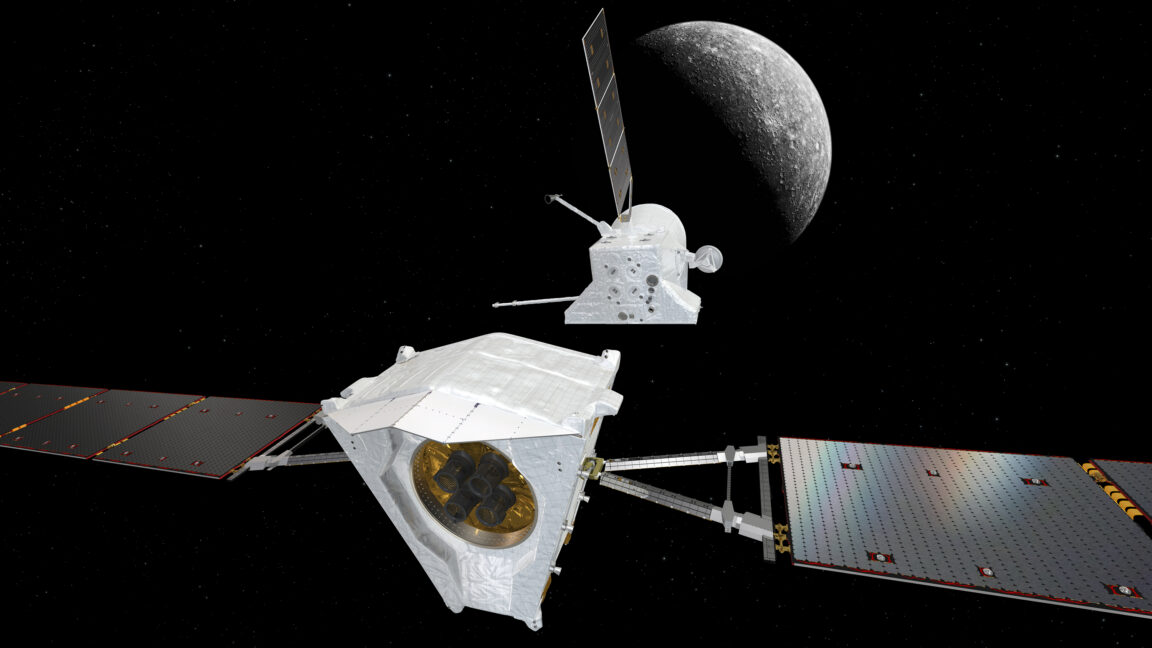
Europe's BepiColombo spacecraft enters its final approach to Mercury after eight years of interplanetary travel, marking a watershed moment for planetary science exploration. The joint mission between the European Space Agency and Japan's space agency JAXA will finally begin detailed orbital operations around the solar system's smallest and innermost planet.
The mission represents one of Europe's most ambitious deep space endeavors. BepiColombo launched in October 2018 and has spent the intervening years executing a complex series of gravitational assists around Venus and Mercury itself to slow its velocity and achieve the proper orbital insertion. This indirect route proved necessary because direct trajectories to Mercury consume prohibitive amounts of fuel given the intense gravitational pull of the sun at that distance from Earth.
Scientists aim to unlock Mercury's fundamental secrets. The planet's extreme conditions, with surface temperatures swinging from 430 degrees Celsius during the day to minus 180 degrees at night, present a natural laboratory for understanding planetary formation and evolution. Mercury's unusual composition, featuring an oversized iron core relative to its rocky mantle, defies standard planetary formation models and offers clues about how terrestrial planets assembled in the early solar system.
The spacecraft carries two orbiters: the Mercury Planetary Orbiter, built by JAXA, and the Mercury Magnetospheric Orbiter, built by ESA. This dual-orbiter design allows simultaneous observation of Mercury's surface, interior, and magnetosphere. The magnetosphere proves particularly intriguing because Mercury, despite being small and geologically inactive, maintains an active magnetic field that scientists do not yet fully understand.
Data collection will focus on Mercury's geological history, magnetic field generation, and interior structure. Ground-penetrating radar and magnetometer instruments will probe beneath the surface to reveal subsurface composition and detect potential water ice deposits in permanently shadowed craters near the poles. Such ice deposits, if present, would revolutionize understanding of Mercury's thermal evolution and water distribution throughout the inner solar system.
The eight-year journey tested spacecraft systems and mission operations extensively. Multiple course corrections and instrument calibrations during cruise ensured the orbiters arrived in optimal condition. ESA and JAXA teams have coordinated across continents to prepare for orbital operations, including finalizing data downlink procedures and establishing ground station support networks.
Mercury exploration fills a critical gap in planetary science. While NASA's MESSENGER mission provided the first detailed orbital reconnaissance from 2011 to 2015, BepiColombo brings upgraded instrumentation and dual perspectives that will answer questions MESSENGER left open. The mission will operate for approximately one Earth year during its primary phase, with potential extensions if systems perform well.
The arrival deadline carries symbolic weight for European space science. BepiColombo represents ESA's commitment to understanding planetary origins through sustained investment in complex deep space missions. Successful orbital insertion and data acquisition will validate European capabilities in navigating the extreme challenges posed by Mercury's proximity to the sun and its harsh radiation environment.