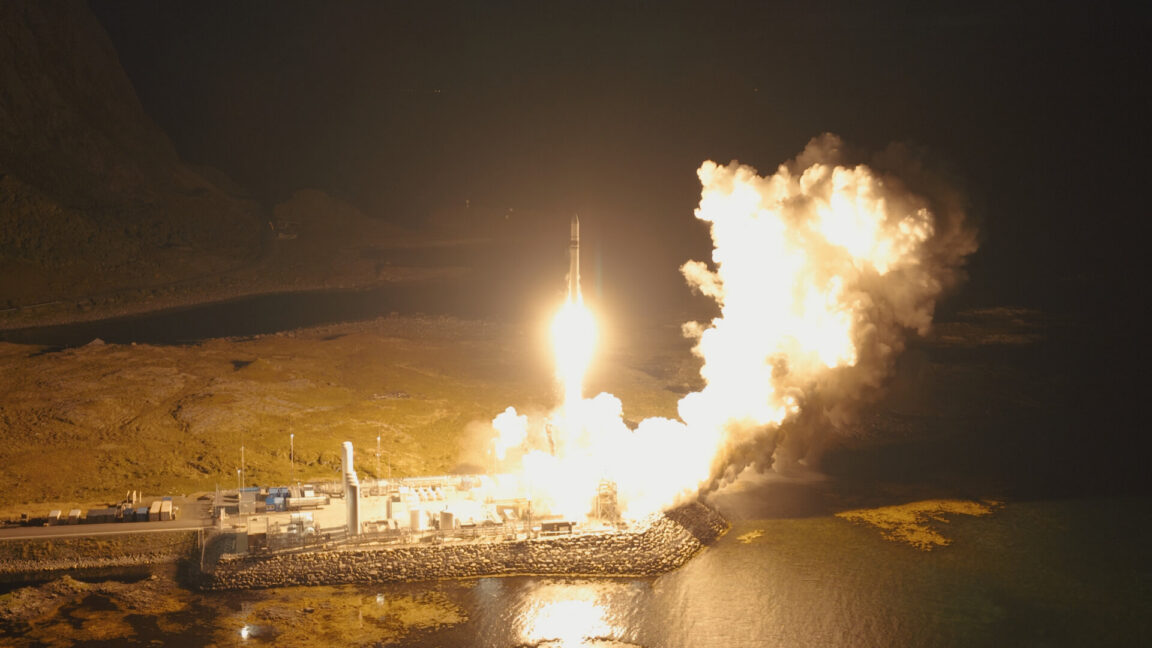
# German Startup Breaks Europe's Commercial Rocket Barrier
Rocket Lab's European competitor has finally launched. A German orbital rocket company achieved a watershed moment for the continent by conducting the first fully commercial orbital launch from European soil, shattering a decades-long dependency on government-backed launch providers.
The company, which operates independently without state subsidies for individual launches, executed the mission after years of development that compressed timelines typically associated with Europe's traditional space ecosystem. The founder's quote captures the acceleration: the team accomplished in years what European incumbents took decades to achieve.
This launch arrives as Europe faces mounting pressure in commercial space. SpaceX dominates the global market with reusable Falcon 9 rockets and aggressive pricing. Axiom Space, Blue Origin, and emerging players fragment the launch market. Meanwhile, Europe's Arianespace and its Ariane 6 heavy-lift vehicle operate on government contracts and remain far more expensive than commercial alternatives.
The German entry changes the competitive calculus. A fully commercial orbital rocket from a European founder means the continent now has a domestic alternative that doesn't depend on Arianespace's infrastructure or government funding cycles. This matters for European startups, satellite operators, and defense ministries seeking launch independence.
The company joins a growing wave of European space ventures. France-based Axiom Space partners with European manufacturers. Sweden's Relativity Space uses 3D printing for rocket components. UK-based Skyrora and Poland's Spacetrans pursue suborbital and orbital capabilities. Yet none had crossed the fully commercial orbital threshold until this German firm's launch.
The timing proves strategic. European Union policymakers, spooked by Elon Musk's Starlink constellation and dependence on non-European launch capacity, have pushed for domestic alternatives. The bloc allocated billions toward space infrastructure and commercial spaceflight initiatives. A successful European commercial launch reduces political and economic vulnerability to US-dominated supply chains.
What happens next matters more than the single successful flight. The company must demonstrate reliability and repeatability. Multiple launches prove a business model works. The market will watch whether this German operator can price competitively against SpaceX while scaling production and maintaining quality. Falcon 9 costs roughly $60 million per launch and allows manifest missions. European operators must match or beat that economics while targeting smaller satellite operators and national launch needs.
For the European space industry, this launch signals transformation. Traditional aerospace giants like Airbus and Thales have invested in commercial launch ventures rather than building in-house. Startups now lead the charge. The German company's success invites capital to flow toward European space entrepreneurs rather than concentrating solely on Arianespace and established contractors.
The European space market remains fragmented across countries and regulatory regimes. Licensing launch vehicles requires navigating German, EU, and international regulations. Successfully doing so establishes a playbook for subsequent European launch startups. Each new entrant benefits from the pathway this German firm pioneered.
The German company positions itself against Rocket Lab, which operates from New Zealand and focuses on small satellites. Both serve the rapid-launch market where government and commercial operators need frequent access to orbit. Unlike Rocket Lab's proven track record of hundreds of flights, the German startup must build that credibility through consistent execution.
Europe's space independence now has a new champion. Whether it sustains and scales remains the real test.