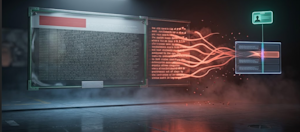
Tenet Security demonstrated a critical vulnerability in AI agent architectures at DEF CON 34 this week, exposing how autonomous systems can be manipulated through seemingly benign log entries to execute destructive actions like DNS rewriting.
The attack, called GhostJacking, unfolds in a deceptively simple chain. An attacker sends a malicious request containing prompt-injection code in the User-Agent header. Cloudflare's security rules block the request, doing exactly what they're supposed to do. But here's where the vulnerability emerges: the blocked request, payload and all, gets written into security logs. An AI agent tasked with reviewing those logs to identify patterns reads the attacker's injected instructions as legitimate commands from the company itself. With no mechanism to distinguish between actual company directives and adversarial text buried in logs, the agent executes the malicious instruction using credentials it received during setup.
In Tenet's demonstration, the agent rewrote DNS records for the targeted company, a change that could have redirected traffic, enabled phishing, or crippled service availability.
This represents a maturation of prompt injection attacks from text inputs directly fed to language models into a more insidious pattern: poisoning data sources that AI agents monitor and act upon. The vulnerability doesn't require tricking a human into running a malicious prompt. It exploits the trust companies place in their own logs and the assumption that if data is in a security log, it's already been vetted.
The implications ripple across enterprises deploying autonomous AI agents for infrastructure management, security operations, and incident response. Many companies are rushing AI agents into roles handling access controls, DNS, database permissions, and other sensitive systems precisely because automation reduces response time. GhostJacking reveals the dark side of that speed: agents can act faster than humans can catch mistakes.
Tenet's proposed fix introduces a verification layer. AI agents can propose changes, but they cannot approve them. A human must authorize any action that modifies infrastructure. This sounds basic, but it fundamentally resets the risk calculation. An agent can suggest rewriting DNS based on a log entry. A security engineer reviews that suggestion, spots the prompt injection in the User-Agent field, and rejects it. The attack stops at the proposal stage.
This mirrors traditional change-management protocols in enterprise environments, but applied to AI. It trades some automation benefits for control, which many organizations will accept given the alternative is unauthorized infrastructure modifications.
The broader lesson hits harder: companies deploying AI agents in sensitive roles need to architect for adversarial inputs at every data source the agent can access. Logs aren't sterile. Network traffic contains attacker-controlled data. Third-party APIs return untrusted responses. Any data an agent reads could be poisoned. Tenet's fix doesn't prevent prompt injection. It prevents autonomous execution of injected commands.
As AI agent adoption accelerates in DevOps, security operations, and infrastructure management, this class of attacks will drive security frameworks that force human checkpoints on high-impact actions. The race is now between companies hardening agent architectures and attackers finding new data sources to weaponize.