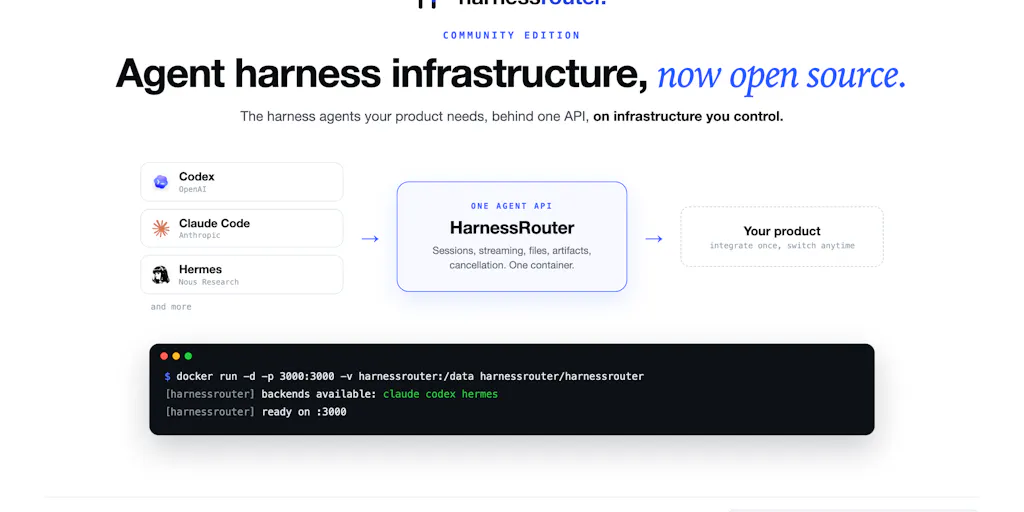
HarnessRouter Community Edition launches as an open-source unified interface for agent harnesses. The tool consolidates management of multiple AI agent frameworks into a single control plane, reducing the complexity developers face when orchestrating diverse agent systems.
The Community Edition targets builders experimenting with multi-agent architectures. Rather than maintain separate integrations for each framework, developers use HarnessRouter as a standardized layer. This approach simplifies API calls, configuration management, and monitoring across heterogeneous agent stacks.
The project addresses a real pain point in the AI agent space. As organizations deploy multiple specialized agents, the operational overhead grows quickly. Different frameworks use different protocols, state management approaches, and communication patterns. HarnessRouter abstracts these differences away.
Open-source positioning lets developers contribute extensions for emerging agent frameworks. Early adopters get free access to what could become infrastructure-level software for agent deployment. The community model also signals the team's confidence in the core value proposition. Rather than gate access, they're seeding adoption among builders who will drive enterprise adoption later.
The timing aligns with accelerating agent deployment cycles. Major cloud providers and AI platforms are shipping agent frameworks, and enterprises are standing up multiple agents simultaneously. A neutral, extensible router sits in a valuable position. Companies deploying agents from OpenAI, Anthropic, and open-source projects all benefit from a single integration layer.
HarnessRouter competes with proprietary agent orchestration platforms and custom internal solutions. Existing low-code platforms like Zapier and Make are exploring agent routing, but HarnessRouter focuses deeper on agent-specific concerns like state synchronization and memory management.
Success depends on community adoption and the team's ability to keep pace with new agent frameworks. Early traction on Product Hunt provides validation. Converting those users into paying customers through premium hosting or enterprise features becomes the business model test. For now, the open-source