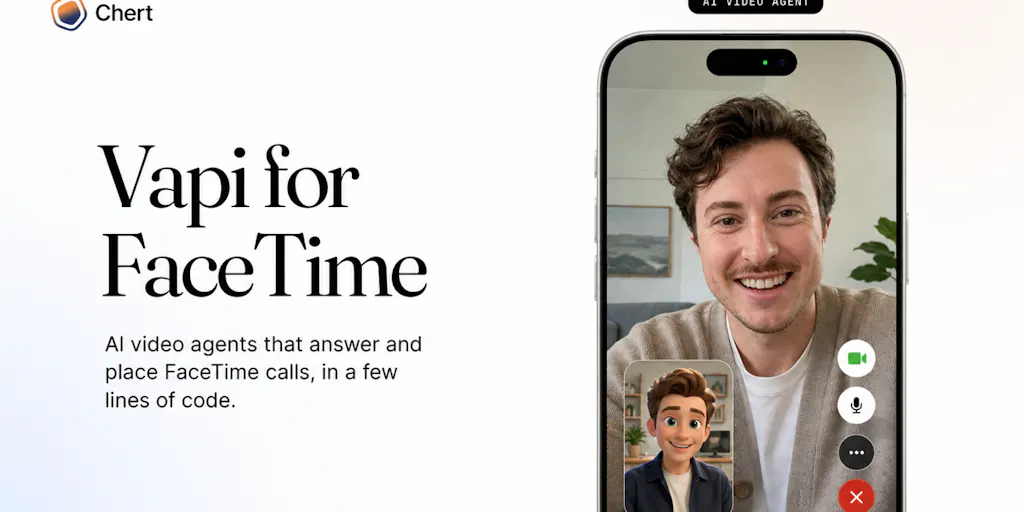
Chert positions itself as a simplified alternative to Vapi, enabling developers to deploy AI video agents through FaceTime with minimal code. The platform abstracts away complexity, letting builders spin up conversational video AI in just a few lines rather than building integrations from scratch.
The positioning is telling. Vapi raised $12 million in Series A funding and established itself as the go-to API for voice agents, serving developers who need pre-built infrastructure for AI phone calls. Chert targets the same developer audience but narrows the focus to video conversations and prioritizes ease of use over feature completeness. For teams that don't need the depth of Vapi's orchestration capabilities, Chert offers a faster path to deployment.
The FaceTime angle matters. Apple's video calling platform reaches hundreds of millions of users, making it a natural distribution channel for AI agents. Rather than forcing users into proprietary apps or web interfaces, Chert agents live where users already video call, reducing friction significantly. This positions the startup in the growing market of conversational AI infrastructure that includes not just Vapi but also Bland AI, which focuses on phone calls, and emerging video-first competitors.
The "few lines of code" promise echoes the developer-first positioning that made Twilio valuable. Chert bets that developers will choose simplicity over comprehensiveness when the simpler tool solves their problem. That's a proven category dynamic. The question becomes whether video agents emerge as a distinct market segment from voice agents or whether they're absorbed into unified conversational AI platforms.
Chert's Product Hunt launch suggests early traction or at least founder conviction. The timing matters too. Video AI adoption is accelerating as models improve and latency decreases. FaceTime integration positions Chert to capture developer mindshare early before larger players like OpenAI or Anthropic potentially bundle video