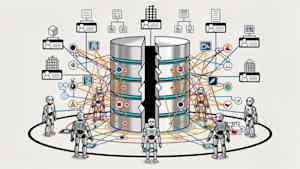
Dun & Bradstreet overhauled its 642-million-business Commercial Graph to serve AI agents instead of humans. The 180-year-old data giant built its flagship database for credit analysts and risk managers who could interpret ambiguous results and wait for query responses. That architecture crumbles when AI agents need instant, deterministic answers for autonomous workflows.
D&B's enterprise customers began deploying agents into credit decisions, procurement, and supply chain operations. The legacy systems couldn't handle the speed and precision requirements. Agents need clean data relationships, unambiguous entity matches, and millisecond response times. Human analysts tolerate friction. Machines do not.
The rebuild represents a fundamental shift in how D&B thinks about its core product. The company now treats agents as a primary consumer category alongside traditional human users. This means restructuring the Commercial Graph's architecture, indexing strategies, and data governance to optimize for machine consumption rather than human interpretation.
The move positions D&B to capture enterprise AI adoption at scale. As companies automate credit, procurement, and supply chain decisions, they need trustworthy commercial data pipelines. D&B controls one of the world's richest datasets on business relationships and risk. But that advantage only matters if the data flows cleanly into agent-powered workflows.
This also reveals a broader pattern across enterprise software. Databases and tools built for human operators require architectural overhaul to serve autonomous AI systems. Response time, data consistency, and determinism matter differently. Companies that rebuild for agents first gain competitive moats. Those that don't risk becoming legacy infrastructure.
D&B's move comes as large language models and agentic AI enter procurement and financial workflows. Coupa Software, SAP Ariba, and other spend-management platforms have announced agent-first roadmaps. Banks and credit platforms are experimenting with AI-driven underwriting.